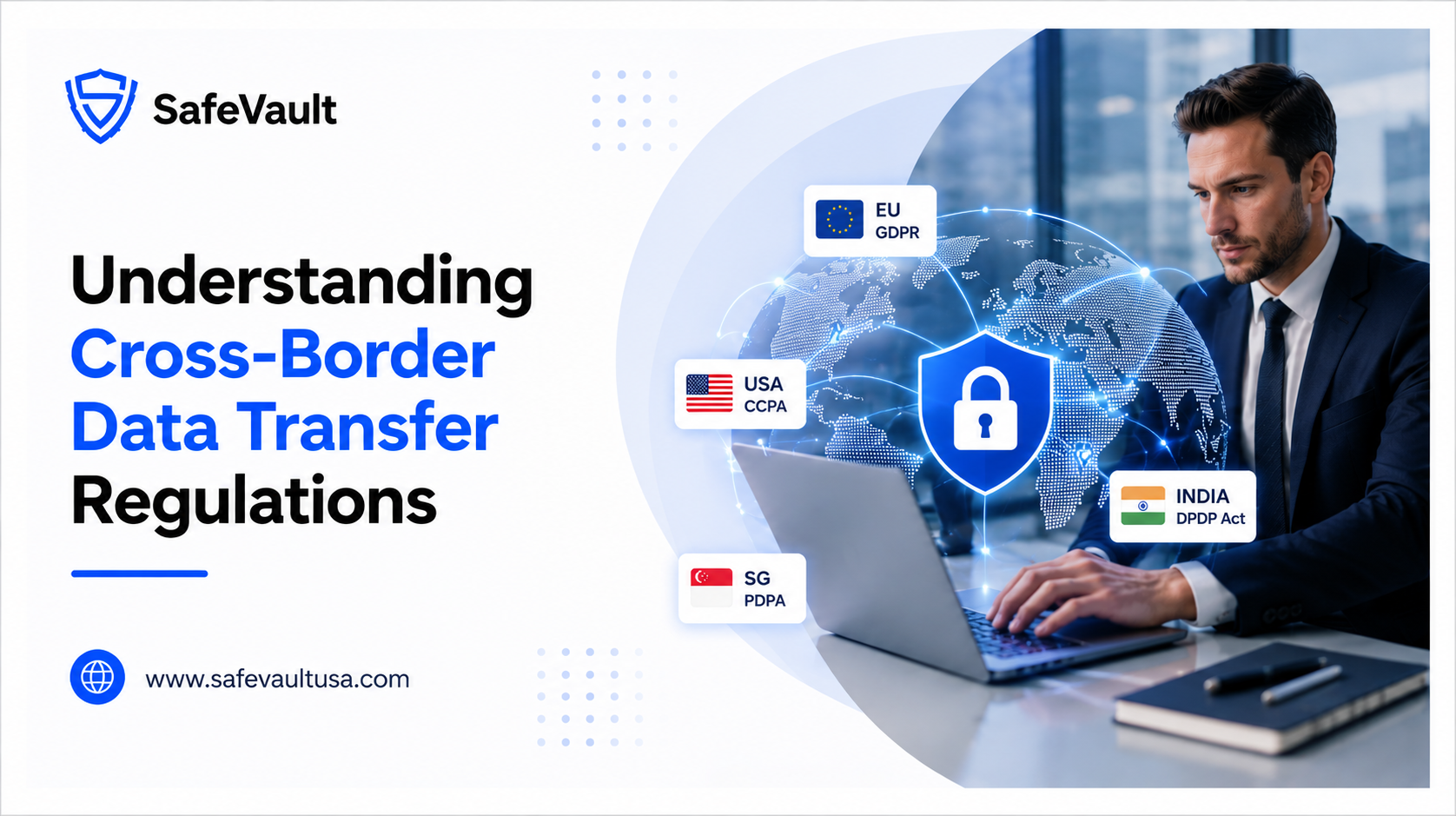
In today's interconnected digital economy, data rarely stays within a single country. Financial institutions serve customers across multiple regions, mortgage companies work with global technology providers, and businesses increasingly rely on cloud-based platforms that store and process information in different parts of the world.
While this global connectivity has created tremendous opportunities, it has also introduced a complex challenge: complying with cross-border data transfer regulations.
For organizations operating in FinTech, mortgage lending, banking, and other highly regulated industries, understanding how data moves across international borders is no longer optional. It is a critical component of risk management, regulatory compliance, and customer trust.
As former IBM CEO Ginni Rometty once said:
"Cybercrime is the greatest threat to every company in the world."
As data continues to move across jurisdictions, businesses must balance innovation with security and compliance.
What Are Cross-Border Data Transfers?
A cross-border data transfer occurs whenever personal, financial, or business information is transmitted, stored, accessed, or processed outside the country where it was originally collected.
Examples include:
A mortgage lender in the United States using a cloud provider with data centers in Europe.
A FinTech company processing customer information through an international software platform.
A financial institution sharing information with overseas vendors or partners.
Employees accessing company data while working remotely from another country.
While these activities may seem routine, they can trigger regulatory obligations depending on the jurisdictions involved.
Many governments have introduced laws that regulate how sensitive information can be transferred across borders and what safeguards must be in place.
Why Cross-Border Data Regulations Matter
The primary goal of these regulations is to protect individuals' privacy and ensure organizations handle information responsibly.
Data protection authorities want to ensure that personal information remains secure regardless of where it is stored or processed.
For businesses, non-compliance can result in:
Significant financial penalties
Regulatory investigations
Operational disruptions
Reputational damage
Loss of customer trust
For FinTech companies and mortgage lenders handling sensitive financial information, the stakes are especially high.
Customers expect organizations to safeguard their data, whether it is stored locally or halfway around the world.
The Growing Global Regulatory Landscape
Over the past decade, governments around the world have introduced increasingly stringent privacy laws.
Some of the most influential frameworks include:
The European Union's General Data Protection Regulation (GDPR)
California Consumer Privacy Act (CCPA)
Brazil's General Data Protection Law (LGPD)
Singapore's Personal Data Protection Act (PDPA)
India's Digital Personal Data Protection framework
Although these regulations differ in scope, they share a common objective: ensuring that personal information remains protected when transferred internationally.
Organizations must understand not only where their data resides but also how it moves between systems, partners, and service providers.
The Impact on FinTech and Mortgage Organizations
Few industries rely on data as heavily as financial services and mortgage lending.
Every loan application, financial transaction, compliance review, and customer interaction generates sensitive information.
This includes:
Financial records
Tax documentation
Credit reports
Employment verification
Identity documents
Because this information often flows through multiple platforms and third-party providers, cross-border compliance becomes a significant operational concern.
Modern FinTech organizations increasingly depend on global infrastructure, cloud services, and digital platforms.
Mortgage lenders often utilize document management systems, customer portals, analytics tools, and underwriting technologies that may process data across multiple jurisdictions.
Without proper governance, organizations can unknowingly create compliance risks.
Why Secure Storage Is More Important Than Ever
As regulatory requirements become more complex, businesses are reevaluating how they store and manage information.
Traditional file storage systems often lack the visibility, security, and control needed to support modern compliance requirements.
Organizations are increasingly adopting solutions such as:
Secure Digital Vault environments
Enterprise Data Vault platforms
Secure Cloud Vault technologies
Cyber Secure Document Storage systems
Compliance Document Storage solutions
These technologies help organizations maintain greater control over sensitive information while supporting regulatory obligations.
A Secure Digital Vault enables businesses to manage documents in a protected environment with advanced access controls and audit capabilities.
Similarly, an Enterprise Data Vault provides centralized management of critical business information while supporting compliance initiatives.
The Role of Encryption in Cross-Border Compliance
Encryption has become one of the most important safeguards for organizations transferring information internationally.
Encrypted Document Storage helps ensure that data remains protected during transmission and while at rest.
When properly implemented, encryption can:
Reduce security risks
Strengthen compliance efforts
Protect customer information
Limit exposure during breaches
Support regulatory requirements
For financial institutions and mortgage lenders, encryption is increasingly viewed as a foundational component of data protection strategies.
Many organizations are integrating Encrypted Document Storage capabilities into broader Data Protection Platform initiatives to improve security and governance.
Secure File Sharing Is Becoming a Business Necessity
Businesses today regularly exchange documents with customers, regulators, vendors, and partners.
Unfortunately, unsecured sharing methods can introduce significant risks.
This is why Secure File Sharing for Business has become an essential capability.
Secure sharing solutions help organizations:
Control access permissions
Track document activity
Protect sensitive information
Maintain compliance records
Reduce data leakage risks
For mortgage lenders exchanging borrower documentation and financial institutions sharing sensitive records, secure collaboration is essential.
Modern Document Security Platform solutions provide the visibility and control necessary to manage these interactions safely.
Legal and Compliance Considerations
Cross-border compliance is not simply a technology challenge. It is also a legal responsibility.
Organizations should establish clear governance frameworks that address:
Data classification
Access controls
Vendor management
Data residency requirements
Audit and monitoring procedures
A Legal Document Vault can play a valuable role in supporting these efforts by ensuring critical records are stored securely and remain accessible for audits, investigations, and regulatory reviews.
Strong governance helps organizations demonstrate accountability and maintain regulatory readiness.
Building Trust Through Responsible Data Management
Customer trust has become one of the most valuable assets in the digital economy.
Consumers want confidence that organizations will handle their information responsibly regardless of where it is stored.
As Warren Buffett famously stated:
"It takes 20 years to build a reputation and five minutes to ruin it."
A single compliance failure or data breach can have long-lasting consequences.
Organizations that prioritize transparency, security, and responsible data management are more likely to earn and maintain customer confidence.
Preparing for the Future
Cross-border data regulations will continue to evolve as governments respond to emerging technologies, cybersecurity threats, and privacy concerns.
Businesses should proactively prepare by:
Mapping data flows across systems and jurisdictions.
Implementing robust security controls.
Utilizing Secure Cloud Vault solutions.
Strengthening encryption practices.
Investing in a modern Document Security Platform.
Improving vendor oversight.
Maintaining comprehensive compliance programs.
As Microsoft Chairman and CEO Satya Nadella observed:
"Trust is at the core of every business."
That principle is particularly relevant in today's global data environment.
Conclusion
Cross-border data transfer regulations are becoming increasingly important for organizations operating in FinTech, mortgage lending, and financial services.
As businesses expand globally and rely more heavily on cloud technologies, understanding how data moves across jurisdictions is critical for maintaining compliance, protecting customer information, and reducing risk.
By investing in Secure Digital Vault solutions, Enterprise Data Vault environments, Cyber Secure Document Storage systems, Secure File Sharing for Business capabilities, Legal Document Vault platforms, Secure Cloud Vault technologies, Encrypted Document Storage solutions, Data Protection Platform strategies, Compliance Document Storage practices, and modern Document Security Platform infrastructure, organizations can build a stronger foundation for both security and regulatory compliance.
In a world where data flows freely across borders, the organizations that succeed will be those that combine innovation with responsibility, security with accessibility, and growth with trust.